Every organism has a set of distinct traits. Some of them are genetic, and some are environmental. These traits are the defining factor in an organisms survival. If an animal inherited a trait that made it so it could not digest its food, that animal will die and its traits will not go on to be in the next generation. This is a cornerstone in the concept of evolution.
Evolution has many constraints, that all depend on the fitness of an individual. Fitness is the survival and reproduction of an individual. These depend on both genetics and the environment in which the individual lives in. The mantis shrimp evolved its eyes in order to help it survive in it’s environment.
Stomatopod eyes are fundamentally different from primate eyes. Primate eyes function like a camera. They have a single focusing lens and only three classes of photoreceptors. This allows the primate to see the differences in natural lights and objects while still having good spatial awareness. Stomatopod eyes have 12 different photoreceptors, and decode color information at the front of their sensory system.
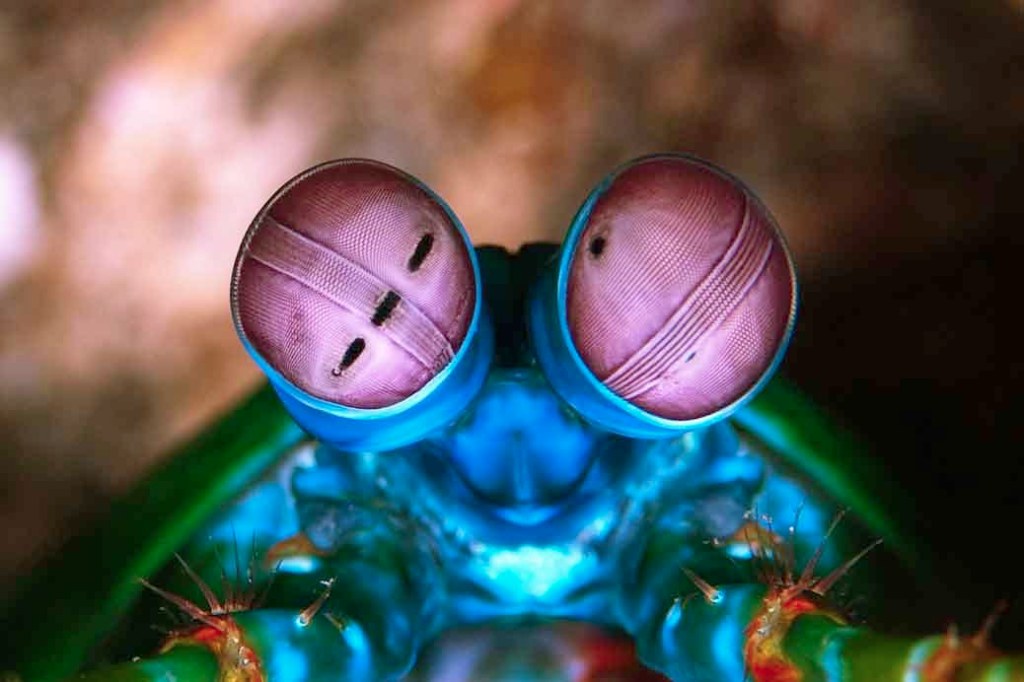
The mantis shrimp uses its eyes like a satelite. They required the ability to see all of their environment and take all the visual information in without first processing it, so that they are able to react nearly instantaneously. This ability does come with a downfall. Mantis shrimp aren’t able to differentiate colors as well as primates, nor do they have as well developed spacial awareness.
Primates would be unable to survive with more photoreceptors, because their ability to survive comes from their ability to know what they are looking at and tell how far away it is. A monkey reaching out for a branch would fall out of the tree because it wouldn’t be able to tell how far away the branch is.
On the other hand, the mantis shrimp doesn’t really need to have as well developed spacial awareness or color differentiation. Rather, they need the ability to react to their environment as quickly as possible in order to hunt and escape from predators.
This is a great example of how two opposing traits are able to cause higher fitness in different species. The animals encountered different constraints on evolution.
One of the many ways species evolve is through natural selection. Natural selection is a difference in the survival and reproductive success of phenotypes. In other words, certain traits give an animal higher fitness (individual reproductive success). The individuals with lower fitness are less likely to reproduce, so their traits will slowly disappear from the population.
 Biological Brilliance